
What Are Manual Trading Systems?
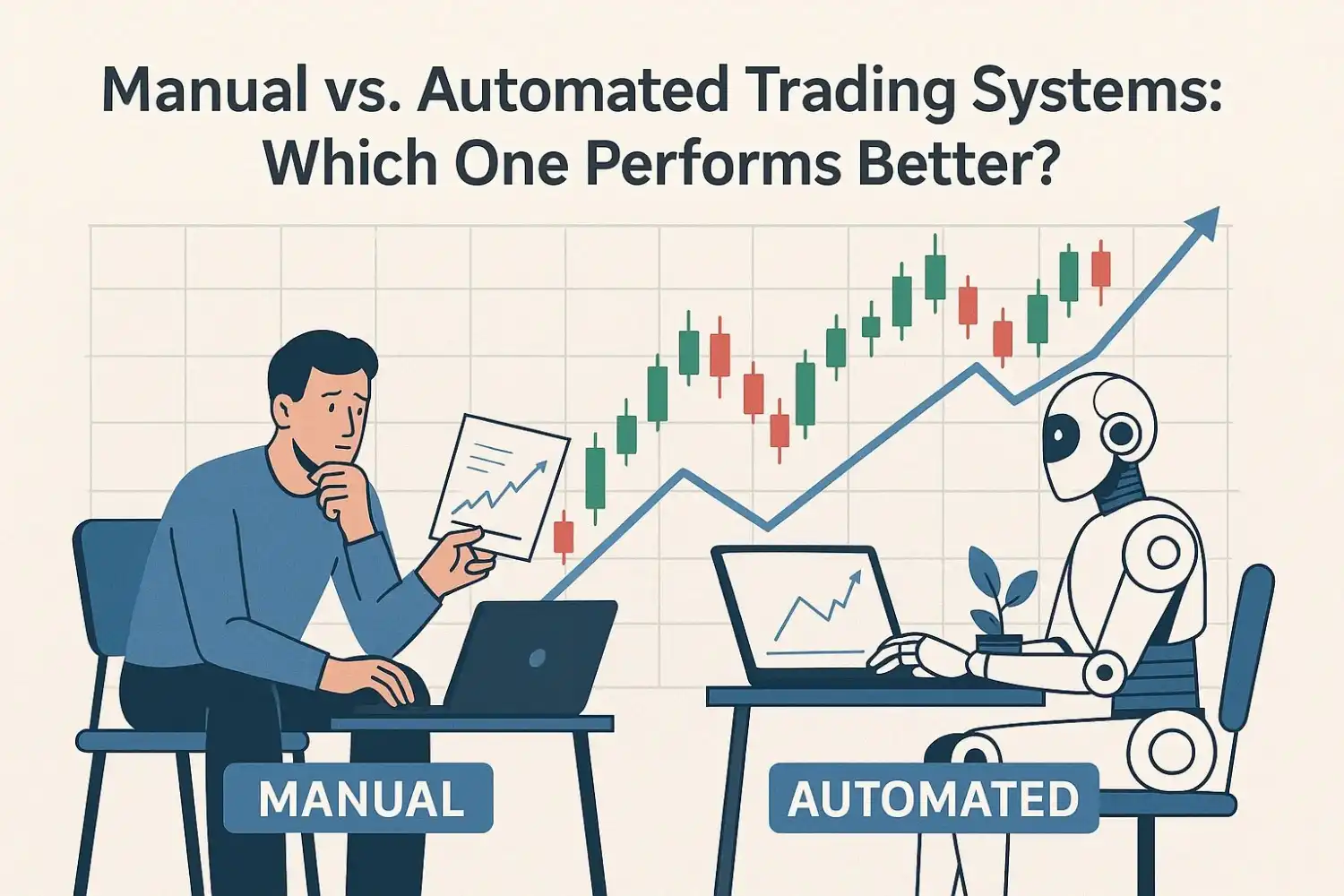
Manual trading systems are trading strategies executed by a human trader without the use of automation or bots. In this approach, a trader analyzes the market using tools such as chart patterns, indicators, and news feeds, and then manually opens or closes positions based on their judgment.
This system emphasizes human discretion, experience, and real-time decision-making. Traders often develop personalized rules and refine them over time based on their intuition and psychological responses to market behavior.
While manual trading provides full control, it also requires continuous focus, emotional discipline, and a deep understanding of technical and fundamental analysis. It’s ideal for traders who enjoy being actively involved and making decisions in real-time.
What Are Automated Trading Systems?
Automated trading systems (also called algorithmic or bot trading systems) are strategies that execute trades based on pre-programmed rules and logic. Once set up, these systems analyze data, identify opportunities, and execute trades without human intervention.
These systems rely on indicators, price action, and mathematical models. They are often built using platforms like MetaTrader 5, NinjaTrader, or Python-based custom scripts. In 2025, many platforms also incorporate AI and machine learning to improve accuracy and adaptability.
Key benefits include:
- 24/7 trading
- Fast execution
- Emotion-free decisions
- Backtesting and optimization capabilities
Automated trading is best suited for traders who prefer data-driven decision-making and scalability.
Performance: Speed and Execution
Winner: Automated Trading Systems
When it comes to speed, automated systems clearly outperform manual ones. Bots can execute orders in milliseconds—much faster than a human ever could. In fast-moving markets like forex or crypto, this speed can make a significant difference in profits.
Automation reduces slippage, avoids missed opportunities, and ensures trades are executed exactly as programmed. For strategies like scalping or high-frequency trading, speed is not just an advantage—it’s essential.
In contrast, manual traders may experience delays in order execution due to hesitation, distractions, or slower reaction times, especially during periods of high volatility.
Performance: Flexibility and Adaptability
Winner: Manual Trading Systems
While automated systems are fast, they often lack the adaptability and creative thinking that human traders bring to the table. Markets are dynamic, influenced by unexpected news, economic reports, and geopolitical events. These factors may require a flexible response that rigid algorithms can’t always provide.
Manual traders can pause, analyze unexpected situations, and make context-based decisions. They can quickly switch strategies, adjust risk, or avoid entering trades when they sense something is off.
In contrast, bots follow rules strictly. Unless programmed to adapt (e.g., using AI or conditional logic), they might continue trading in suboptimal conditions, leading to losses.
Risk Management and Emotional Discipline
Winner: Automated Trading Systems
One of the biggest pitfalls in manual trading is emotional interference. Fear, greed, hesitation, and revenge trading are common psychological barriers that can cloud judgment and lead to costly mistakes.
Automated systems, on the other hand, are emotionless. They follow logic, not feelings. This helps in consistent execution, sticking to stop-losses and profit targets, and avoiding overtrading.
That said, automation isn’t entirely risk-free. Poorly coded strategies, lack of supervision, or excessive reliance on historical data (overfitting) can lead to large losses. But in general, automation handles emotions far better than most humans.
Performance Tracking and Backtesting
Winner: Automated Trading Systems
Backtesting is the process of testing a strategy on historical data to evaluate its performance. Automated systems are ideal for this. Traders can run simulations over years of data, optimize parameters, and assess potential profitability before risking real capital.
Platforms like MetaTrader 5, TradingView, and custom Python scripts allow for detailed backtesting with metrics such as:
- Win/loss ratio
- Maximum drawdown
- Profit factor
- Sharpe ratio
Manual systems, however, are harder to backtest objectively. While a trader can review historical charts and imagine what they would have done, it’s inherently biased and inconsistent. There’s no accurate way to simulate emotions and real-time decision-making retrospectively.
Ease of Use and Learning Curve
Winner: Manual Trading Systems
While automated trading is powerful, it has a steep learning curve. It often requires:
- Coding skills (e.g., MQL5, Python)
- Strategy development knowledge
- Technical infrastructure setup (VPS, latency optimization)
- Continuous monitoring and debugging
For beginners, this can be overwhelming. Manual trading, on the other hand, is more accessible. Most brokers offer intuitive platforms with drag-and-drop indicators, charting tools, and user-friendly interfaces.
Learning how to trade manually helps new traders understand market structure, price behavior, and strategy logic—foundational knowledge even for those who plan to automate later.
Costs and Infrastructure
Winner: Manual Trading Systems
Manual trading systems are often less expensive to start. All you need is a trading account, basic analysis tools, and perhaps a course or mentorship. There’s no need to invest in trading bots, VPS hosting, or premium backtesting software.
Automated trading, especially algorithmic systems, may involve:
- Development or licensing fees for bots
- Cloud or VPS costs to ensure uptime
- Subscription to premium data feeds
- Maintenance and technical support
While these costs may be justified by performance, they can be a barrier for small retail traders starting out with limited capital.
Strategy Complexity and Execution Consistency
Winner: Automated Trading Systems
Complex strategies involving multiple conditions, timeframes, or instruments are easier to implement through automation. A bot can monitor dozens of charts simultaneously, waiting for precise conditions before entering a trade.
Consistency is another major advantage. Once coded correctly, an automated system will never deviate from its logic—it executes every trade exactly the same way. This reduces variability and increases statistical reliability over time.
Manual traders, however, may struggle with consistency. Distractions, fatigue, or changing moods can affect how a trader executes the same setup on different days.
Scalability and Volume of Trades
Winner: Automated Trading Systems
Automated systems are inherently more scalable. A single bot can handle hundreds of trades per day across multiple currency pairs or assets without any drop in efficiency. This makes them ideal for hedge funds, prop traders, and institutional investors.
Manual trading is limited by human capacity. Most traders can only focus on a few charts at a time and may find it difficult to manage multiple open positions or high-frequency strategies.
If your strategy involves volume, automation is the clear winner.
Real-World Examples and Performance Comparisons
In practice, both systems have shown strong performance—but context matters.
For example:
- High-frequency trading firms rely exclusively on automation to make thousands of trades per second using sophisticated algorithms and co-location services near exchanges.
- Retail swing traders often prefer manual systems where they can analyze charts in the evening, place a few trades per week, and hold them for days or weeks.
- Hybrid systems—where the trader uses automation for signals and manual confirmation for execution—are growing in popularity due to their balance of speed and judgment.
There’s no universal “better” option. The winning system depends on the trader’s strategy, capital, and goals.
Choosing the Right System for You
Here are some guiding questions to help you decide:
- Do you prefer hands-on involvement or passive income?
- Manual trading suits active participation.
- Automated systems are ideal for hands-free trading.
- Are you comfortable with coding and technical setup?
- If yes, automation opens up many opportunities.
- If not, manual trading is a good place to begin.
- What’s your capital size and time availability?
- Smaller accounts and part-time traders often start manually.
- Larger accounts and full-time traders may invest in automation.
- Are you prone to emotional decision-making?
- If yes, automation can protect you from yourself.
Conclusion: Manual vs. Automated—Who Wins?
So, which trading system performs better—manual or automated?
The answer depends on context.
- Automated trading systems excel in speed, consistency, emotion-free execution, and scalability. They dominate in high-frequency and data-intensive strategies.
- Manual trading systems offer flexibility, adaptability, and human insight, which can be critical during market shocks, news events, or uncertain conditions.
In 2025, many successful traders use a hybrid approach, combining automation for analysis and signal generation with manual oversight for final execution. This offers the best of both worlds.
Ultimately, the best system is the one that aligns with your skills, resources, and trading psychology. Test both approaches, track performance, and evolve with experience. The markets will always change—your strategy should too.