
Halal or haram: Is Forex permitted in Islam? This comprehensive tutorial sheds light on whether forex is halal, the stance of scholars on forex trading, the profitability of forex trading, and the legality of forex trading in the UK.
“Is forex halal?” is one question that is becoming more popular as more Muslims turn to online forex trading. Forex is a fast and flexible money-earning business opportunity. However, in Islamic finance, everything is not based on profitable business opportunities. Islamic finance is based purely on guidelines that ensure that fairness and morality are maintained.
Forex trading entails exchanging different currencies. This is not prohibited in Islamic law. The exchange of currencies dates back to when trade started. The problem lies not in what is being traded but in how it is traded in today’s financial markets.
In deciding whether Forex is halal or haram, therefore, we have to refer to and examine the principles and teachings under which Forex can be considered as halal or haram under Islamic laws—Ribah (Interest), Gharar (Uncertainty), and Maisir (Gambling).
Is Forex Trading Halal in Islam According to Scholars?
When academics explore the concept of forex trading being halal in Islam, they never give an easy answer. It all depends on the way they structure the transaction and how they make their profits.
The first issue is that of interest fees, which are commonly referred to as ‘swap fees’ or ‘rollover fees.’ Most traditional forex trading accounts charge interest fees on each overnight transaction that a trader makes. This is an outright form of ‘ribâ’ that is strictly forbidden under Islamic law. If a trader pays or collects interest fees, then forex trading is completely haram.
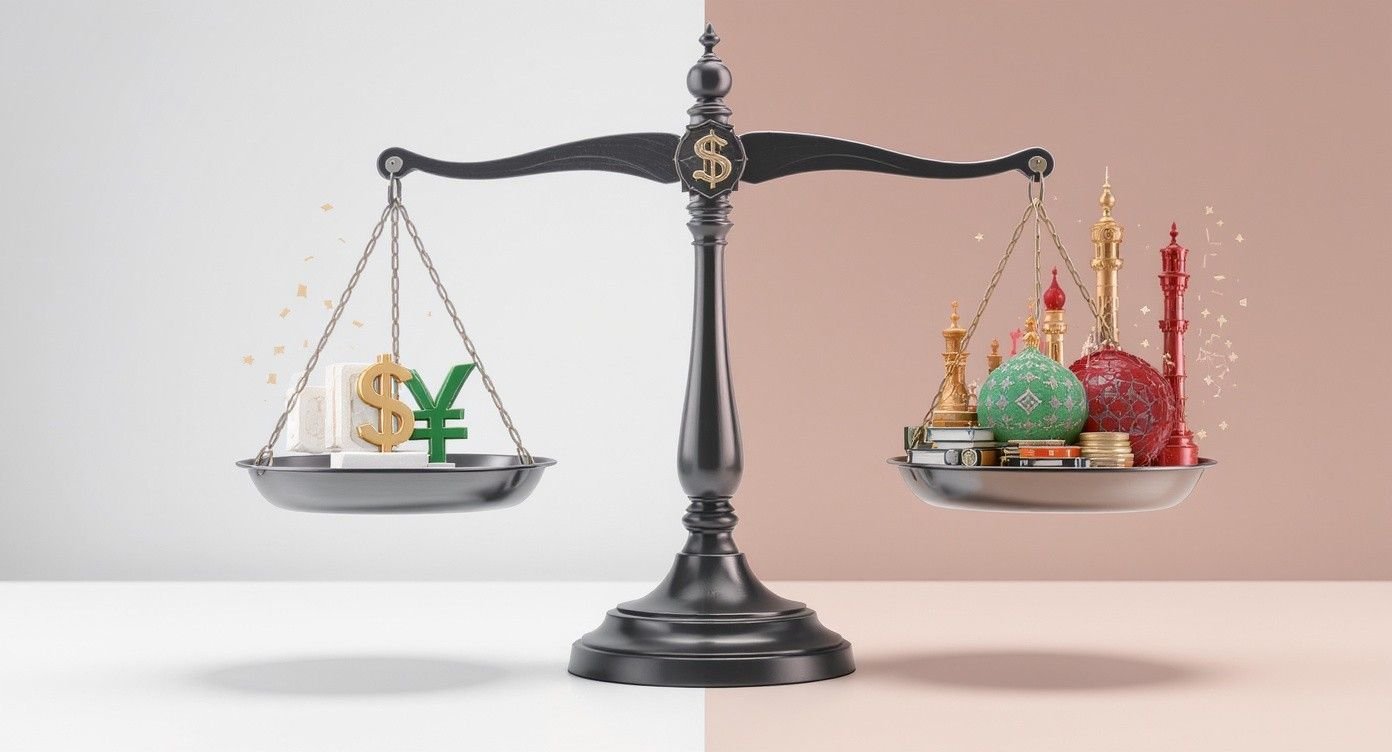
To overcome such problems, Islamic forex accounts, also known as swap-free accounts, have been provided by most forex brokers today. With such accounts, all interest payments will be eliminated. The brokers will then benefit through fees or spreads. Some Islamic scholars feel that such fees will be acceptable as long as they are service fees and not disguised interest.
Another important issue is whether currency exchange takes place without delay. Sharia demands that, when two currencies are exchanged, there must be a transfer of possession without any delay. Nowadays, on all the advanced forex platforms, trading is done through electronic means in seconds. Some scholars consider this constructive possession, while others believe that the delayed settlement is ambiguous. This is one more reason why there are varied views.
Speculation, Gambling, and the Forex Market
One of the most popular complaints about trading Forex is that it is similar to gambling. This is more or less an accurate complaint, although it’s also occasionally an inaccurate complaint.
In case a trader chooses the blind approach, relying solely on the price movements without performing analyses and managing risks, this process turns out to be almost gambling. Islam completely prohibits earnings generated from gambling activities.
However, when it comes to the forex market trade carried out as a result of research, technical analysis, and economic fundamentals, it is considered somewhat different by academics. In this scenario, it could be said that it is not an individual taking gambles.
Trader intentions and actions do count. When forex is considered a casino, it borders on haram, although technically it may be an Islamic account.
The Role of Leverage in Determining Whether Forex Is Halal
Another controversial issue is using margin leverage in forex trading. This allows traders to gain huge positions with relatively small capital. While margin can multiply profits, it may also multiply losses and emotional decision-making.
Some experts feel that it is offensive because the process of borrowing involves a certain amount of money that is advantageous to the broker. Others do not mind it, provided no interest is charged, and the conditions are transparent.
From a practical perspective, one of the leading causes of failure among traders is excessive leverage. Even if leverage is technically halal, its abuse makes trading a form of wild speculation, which goes against Islamic ethical principles.
So, Is Forex Halal or Haram?
The truth is not black and white. Forex trading is not necessarily halal and is not necessarily haram either; this is dependent on certain conditions being met. If a forex trader is using an Islamic swap-free account and is not charging or paying any interest, as long as he is not a gambler, then forex trading is considered permissible.
On the other hand, in the presence of interest, careless trading, and/or speculation for profit without analysis, trading in foreign exchange becomes an illicit activity.
Anyone who says that Forex trading is always halal and always haram is being simplistic about it.
Is Forex Trading Profitable in Reality?
Now let’s remove the fantasy: yes, forex trading can be very profitable, but most traders lose money. It’s not because the market is a scam; it’s just that people don’t give enough respect to the discipline involved.
Profitability in forex trading is based on patience, education, emotional control, and risk management. Consistent profits come gradually, not by some overnight dramatic win.
From an Islamic point of view, such an unrealistic pursuit of profits is dangerous. It cultivates greed, impatience, and behavior much akin to gambling. Even if a given trading setup is halal, a trader’s mindset might turn the activity spiritually harmful.
Forex trading is actually like any other kind of trading: it should be considered a skill rather than a means or gateway to instant wealth.
Is Forex Trading Legal in the UK?
Yes, it is legal to trade on the foreign exchange market in the UK. Foreign exchange brokers who offer their services within the UK are supervised by the Financial Conduct Authority (FCA).

But what is considered valid under UK law does not necessarily make a particular thing halal. An action may fall under the category of a trading activity and yet not conform to Islam. It is important for Muslims, as forex traders, to make sure that their actions meet the UK laws as well as the Sharia.
Thus, if an FCA-regulated broker charges interest, it may be legal; however, for a Muslim trader, it remains haram.
Is Forex Halal for Muslims Living in the UK?
For Muslims living in the UK, the obligation is greater, not less. Availability of reputable brokers and Muslim accounts eliminates many reasons for a lack of knowledge.
A Muslim trader also needs to ensure that the broker provides a genuine Islamic account and is aware of the fee structure. There also needs to be alignment between trade activities and Islamic values.
Blindly following trades, following signals on social networks, and acting out of greed contradicts the assertion that forex market trading is taking place in a halal manner.
Summary
This follows the reality that most news articles never dare to explain. If you are not willing to learn, control yourself, check out the brokers, and follow Islamic rules instead of just profits, you cannot engage in this forex business in any case.
If you enter into Forex trading with knowledge, discipline, sound intentions, and an appropriately Islamic-linked account structure, Forex trading could be allowed or even profitable.
People will mostly fail when dealing with foreign exchange transactions, not because it is haram, but rather as a result of dealings that can best be categorized as irresponsible.
FAQs
Is forex halal according to Islam?
One of the questions commonly raised in relation to forex trading is its validity according to the principles of Islam, or, in other words, is forex trading “halal” or “haram” by the standards of Islam? However, the fact is that the nature of forex trading is neither halal nor haram in Islam, but rather its validity depends on the nature of the trading activity it involves and whether or not it.
Is forex trading halal in Islam for beginners?
For example, as far as beginners are concerned, it can easily become haram in the sense that it should be done by persons who know what they are doing. Without discipline in matters related to money, it can easily resemble gambling.
Is forex trading profitable in the long term?
Forex trading is lucrative, although most people lose money as a result of poor discipline and unrealistic expectations. Such trading needs education, patience, and proper control of risks to be profitable. Forex trading should never be considered as an ‘easy money’ skill.
Is forex trading legal in the UK?
Yes, Forex trading in the UK is legal provided it is carried out through brokers who are approved by the Financial Conduct Authority (FCA). This makes Forex trading transparent and secure for traders. But this does not mean that Forex trading in the UK is Halal.
Do Islamic forex accounts make forex halal?
An Islamic forex account gets rid of the interest charges, making a huge step toward halal trading; traders still cannot gamble or wildly speculate. Having an Islamic account does not make Forex trading completely halal.