

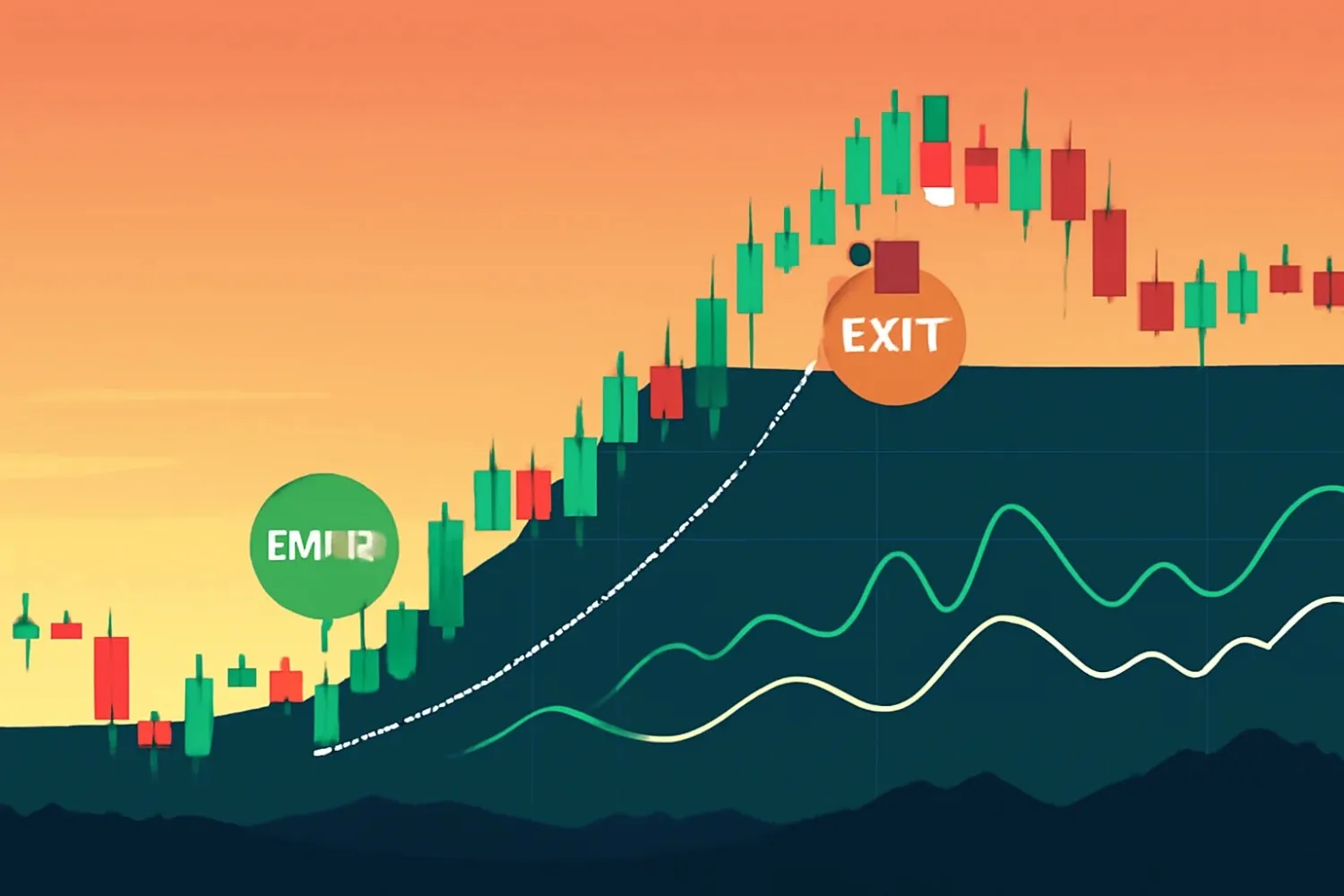
Introduction: The Importance of Entry and Exit Points
One of the most crucial aspects of a successful trading strategy is the timing of your entries and exits. Even the best strategy can fall short if you enter the market too early or too late, or if you exit prematurely or hold a position too long. Optimizing entry and exit points ensures that you enter profitable trades and exit them at the most favorable times, maximizing your potential for success.
In this article, we’ll explore how to optimize entry and exit points in your trading system. We’ll cover essential strategies, tools, and techniques to fine-tune your timing for better performance, consistency, and risk management.
1. Defining Entry and Exit Points
Before diving into optimization strategies, it’s important to understand what constitutes entry and exit points in trading.
-
Entry Point: The price at which you open a position. This is determined by specific conditions, whether it’s a breakout, pullback, or technical signal.
-
Exit Point: The price at which you close your position. Exits can be determined by reaching a profit target, a stop-loss, or any other predefined exit strategy.
Key Questions for Entry and Exit Optimization:
-
When do I enter a trade?
-
How do I determine the best time to exit a trade?
-
What signals or conditions trigger my entry and exit?
-
What are the optimal stop-loss and take-profit levels for my strategy?
Optimizing these points involves improving your decision-making process for these critical stages of a trade.
2. Use Technical Indicators to Identify Entry Points
One of the most common ways to optimize entry points is to use technical indicators. These indicators are mathematical calculations based on price, volume, or open interest that help you determine the most likely price movements.
Popular Technical Indicators for Entry Optimization:
-
Moving Averages: Moving averages (such as the Simple Moving Average or Exponential Moving Average) can be used to identify trend direction. A crossover strategy (e.g., when a short-term moving average crosses above a long-term moving average) is a common entry signal.
-
Relative Strength Index (RSI): RSI measures the strength of a price movement and can help you identify overbought or oversold conditions. For example, entering long positions when RSI crosses above 30 (indicating the market is oversold) can be an effective strategy.
-
MACD (Moving Average Convergence Divergence): MACD is a momentum indicator that identifies shifts in the strength and direction of a trend. A common entry point is when the MACD line crosses above the signal line, indicating upward momentum.
-
Bollinger Bands: Bollinger Bands measure volatility. You can use the strategy of entering when the price breaks out of the band, indicating a strong move in the market.
-
Fibonacci Retracements: Fibonacci levels can help identify support and resistance zones. Entering trades after price retracements to these key levels can help optimize entries during trending markets.
3. Use Price Action for Entry Optimization
While indicators are useful, price action remains one of the most reliable ways to identify optimal entry points. By analyzing candlestick patterns, support and resistance zones, and market structure, you can time your entries with precision.
Price Action Methods to Optimize Entries:
-
Candlestick Patterns: Candlestick patterns like Doji, Engulfing, and Hammer can help identify reversal or continuation signals. For instance, a bullish engulfing pattern at support could signal an optimal entry point for a long trade.
-
Support and Resistance: Identifying key support and resistance levels on the chart can help you enter trades at areas where price is likely to reverse or break out. A breakout above resistance or a bounce from support can provide optimal entry points.
-
Trendlines: Drawing trendlines helps identify trend direction and possible reversal points. A trendline break can signal a change in the market and provide an entry signal.
Using price action enables traders to make decisions based on real-time market behavior, which is crucial for identifying high-probability trades.
4. Optimize Exit Points Using Risk-Reward Ratios
A crucial part of optimizing both entry and exit points is understanding the relationship between risk and reward. The risk-reward ratio measures the potential profit versus the potential loss of a trade, helping you determine whether the trade is worth taking.
Setting Exit Points with a Favorable Risk-Reward Ratio:
-
Set Logical Stop-Loss Levels: Stop-loss orders should be placed based on technical factors such as recent swing highs or lows, rather than arbitrary distance from your entry point. A good stop-loss placement ensures that you don’t risk too much on a single trade.
-
Set Realistic Take-Profit Levels: Take-profit levels should be set at logical price targets, often at previous support or resistance levels. Fibonacci extensions can help predict potential take-profit levels based on price extensions from previous moves.
-
Adjust Exit Points Dynamically: Use trailing stops to lock in profits as the trade moves in your favor. A trailing stop can move with the price to protect gains and exit the trade once the price retraces by a set amount.
Maintaining a favorable risk-reward ratio ensures that even if your win rate is lower, your overall profitability will be positive as long as the rewards outweigh the risks.
5. Backtest and Forward Test for Entry and Exit Optimization
After optimizing your entry and exit points, it’s essential to backtest and forward test the system to validate the effectiveness of your strategies. These testing methods help ensure that your optimized entry and exit points align with real-world market conditions.
Backtesting for Optimization:
-
Historical Data: Backtesting involves applying your optimized entry and exit points to historical market data. This allows you to assess the strategy’s performance over different market conditions.
-
Performance Metrics: Measure key performance metrics such as win rate, profit factor, maximum drawdown, and risk-adjusted return to evaluate the success of your entry and exit strategies.
Forward Testing for Optimization:
-
Demo Accounts: Forward testing on a demo account allows you to assess how your system performs in real-time market conditions. This is especially useful for validating your entry and exit points without risking real capital.
-
Small Live Accounts: Once you’ve tested in a demo account, forward testing with small capital on a live account helps assess real execution, slippage, and emotional aspects of the trade.
By using both backtesting and forward testing, you ensure that your entry and exit points are not only theoretically sound but also practically effective in the live market.
6. Incorporate Market Sentiment and News Events
Optimizing entry and exit points is not just about technical indicators; market sentiment and news events can significantly impact price action. Trading during high-impact news events can lead to substantial price swings that may invalidate your technical setups.
How to Optimize Entry and Exit with Market Sentiment:
-
Monitor News: Use an economic calendar to stay updated on upcoming events like earnings reports, central bank announcements, and geopolitical developments.
-
Sentiment Indicators: Tools like the COT Report (Commitment of Traders) or social media sentiment analysis can provide insights into market sentiment, helping you time entries and exits better.
Adapting your entry and exit points based on sentiment allows you to adjust to market changes and avoid being caught in volatile price moves caused by news events.
Conclusion: Mastering Entry and Exit Points for Success
Optimizing entry and exit points is an essential part of developing a profitable trading system. By combining technical indicators, price action analysis, risk-reward ratios, and sentiment analysis, you can create a strategy that maximizes profits while minimizing risk. The key is to refine your approach continually through backtesting, forward testing, and market adaptation to ensure your strategy remains robust in varying conditions.
Whether you are using technical setups, price action strategies, or machine learning-based methods, timing your entries and exits effectively can make the difference between a profitable and unsuccessful trade. By incorporating these techniques, you’ll optimize your trading system and increase your chances of success in the market.