

Introduction: The Dangers of Overfitting in Trading Systems
Optimization is a critical part of developing a profitable trading system. By adjusting your system’s parameters to maximize historical returns, you can increase its chances of success. However, there’s a fine line between optimization and overfitting.
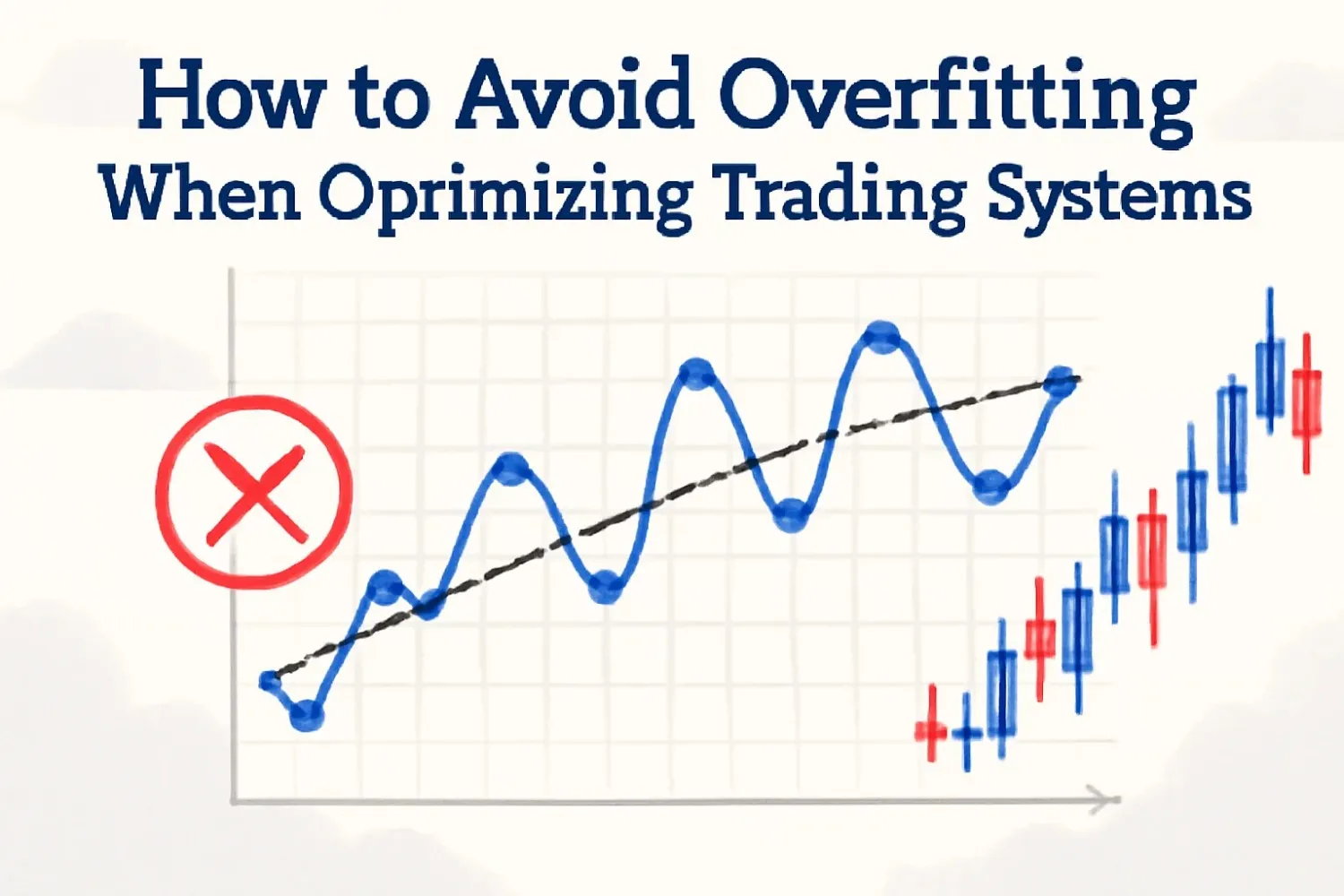
Overfitting occurs when a system is too closely tailored to past data, making it perform exceptionally well on historical data but fail in real-time, live market conditions. While it’s tempting to push a strategy to its absolute limits during backtesting, overfitting can ruin the performance of your trading system in the future.
This article will walk you through the dangers of overfitting and provide practical strategies to avoid it when optimizing your trading system.
What is Overfitting in Trading Systems?
Overfitting happens when a trading strategy is too finely tuned to historical data. Essentially, it means the system has been optimized so perfectly for past conditions that it becomes fragile and rigid when applied to new or unseen data. In the world of trading, this is a major risk because financial markets are inherently unpredictable, and past performance often doesn’t predict future results.
Why Overfitting Happens:
-
Excessive Parameter Tuning: When you adjust every parameter (like moving averages, stop-loss levels, etc.) to maximize profits on past data, the strategy becomes too specific to that data.
-
Optimizing for Profit: While tweaking parameters to increase profitability seems like a good strategy, it can lead to a perfectly tailored system that works in historical data but cannot adapt to future volatility.
-
Overlooking Market Noise: Market data includes random fluctuations that have no predictive value. Overfitting a model often results in a strategy that reacts to this noise rather than the core market signals.
Why Overfitting Ruins Your System:
An overfitted system may show high profitability in backtests, but it will likely struggle in live trading. The performance on historical data becomes an illusion because the model is too fine-tuned to the quirks and noise of that data. Once the market conditions shift, the system will no longer perform as expected, leading to losses and frustration.
Signs That Your Trading System May Be Overfitted
Understanding the signs of overfitting can help you identify when your system is at risk.
1. Excessive Parameter Sensitivity
If small changes in the parameters (e.g., stop-loss levels, timeframes, or indicator settings) drastically affect the performance of your system, it’s a clear sign that your system is too sensitive to historical data. An overfitted system will show huge profits in backtesting with very specific settings, but it will fail when even slight market changes occur.
2. Unrealistic Backtest Results
Backtesting may generate returns that seem too good to be true, especially if your system shows extremely high profits or an impossibly low drawdown. If the results seem too perfect, the system is likely overfit to the historical data, and the high returns are an artifact of over-optimization.
3. Lack of Robustness Across Market Conditions
An overfitted system will likely perform well in specific market conditions but poorly when tested under a variety of market environments. If your strategy works in a bull market but struggles during a bear market or volatile periods, it’s a sign that it may not be adaptable enough for future conditions.
How to Avoid Overfitting When Optimizing Your Trading System
Avoiding overfitting is essential for creating a trading system that can adapt to future market conditions and perform consistently over time. Below are some practical strategies to help you optimize your system without falling into the trap of overfitting.
1. Use Out-of-Sample Data
One of the most effective ways to avoid overfitting is to test your system on out-of-sample data—data that wasn’t used during the optimization phase. This ensures that the system isn’t just tailored to past conditions but is capable of generalizing to new data.
How to Implement This:
-
Split your data into in-sample (used for optimization) and out-of-sample (used for validation).
-
After optimizing your strategy, test it on the out-of-sample data to assess its performance.
-
If the strategy works well on both in-sample and out-of-sample data, it’s likely a more robust system that’s not overfitted to historical noise.
2. Avoid Over-Optimizing Parameters
While tweaking your trading system’s parameters might increase profits during backtesting, over-optimization can lead to a fragile model. Instead of focusing on achieving the highest possible performance, aim for reasonable, stable settings that don’t rely on small adjustments to perform well.
How to Avoid Over-Optimizing:
-
Limit the number of optimization parameters. Stick to a few key parameters rather than optimizing every possible variable.
-
Use a reasonable range of values for each parameter and avoid fine-tuning them to the exact values that perform best on historical data.
-
Keep it simple: Focus on simplicity by choosing more robust indicators (e.g., moving averages, RSI) rather than complex ones with many tunable parameters.
3. Use Walk-Forward Testing
Walk-forward testing is a technique where you optimize your system on a segment of historical data and then test it on the next segment of data. This approach allows you to check if the system can adapt to new data rather than being tailored exclusively to a specific period.
How to Use Walk-Forward Testing:
-
Divide your data into rolling periods: For example, divide the data into 6-month periods and optimize your strategy on the first 6 months, then test it on the next 6-month period.
-
Repeat this process: Continue walking forward through the dataset, optimizing and testing the system on each new segment.
-
Assess performance: After completing the walk-forward tests, evaluate the system’s performance across all periods to see if it can adapt to different market conditions.
Walk-forward testing provides more realistic results and helps ensure your system isn’t too reliant on a specific period of historical data.
4. Use Simpler, More Robust Systems
While complex strategies with many parameters may look good on paper, they often have a high risk of overfitting. Instead of building overly complicated systems, focus on simpler strategies that are more robust and can perform well across different market conditions.
How to Build Robust Systems:
-
Start with a simple rule-based system that relies on basic indicators (e.g., moving averages, support/resistance levels).
-
Avoid excessive reliance on multiple indicators with fine-tuned parameters.
-
Focus on robust risk management rules like dynamic position sizing and stop-loss strategies that work in various conditions.
Simpler systems are often more adaptable and can handle a broader range of market conditions without becoming overfit.
5. Monitor Real-Time Performance Regularly
Backtesting and forward testing are essential, but real-time performance monitoring is crucial for identifying and addressing overfitting. Even after you deploy a strategy, you need to track its performance and make necessary adjustments.
How to Monitor Real-Time Performance:
-
Track metrics like win rate, drawdown, and risk-to-reward ratio during live trading or paper trading.
-
Compare live performance with backtest and forward test results to check if the system is still performing as expected.
-
Adjust your system based on real-time feedback, and don’t be afraid to make small tweaks to improve its performance.
6. Test Across Different Market Conditions
It’s crucial to test your system across a variety of market conditions to ensure it can handle volatility and low-volatility periods, as well as trending and range-bound markets. Systems that perform well in only one market condition are likely overfitted.
How to Test Across Market Conditions:
-
Include different market regimes in your backtesting (e.g., bull markets, bear markets, sideways markets).
-
Test during high-volatility periods, such as after major economic news, to see if your system can handle large price movements.
-
Use real-time forward testing to validate your strategy’s ability to perform in different market conditions.
Conclusion: Achieving Robust and Adaptive Systems
Overfitting is one of the biggest dangers when optimizing trading systems. By over-tuning your strategy to fit historical data, you risk creating a fragile system that performs poorly under real-world conditions. To avoid this, focus on using out-of-sample data, walk-forward testing, and robust risk management to ensure your system is adaptable to different market conditions.
The key is not to optimize for perfect performance on past data, but to build a system that performs well in both historical and future conditions, is simple, and robust enough to adapt to market changes.
By following these best practices, you’ll ensure your trading system remains profitable, reliable, and flexible in the unpredictable world of live markets.