

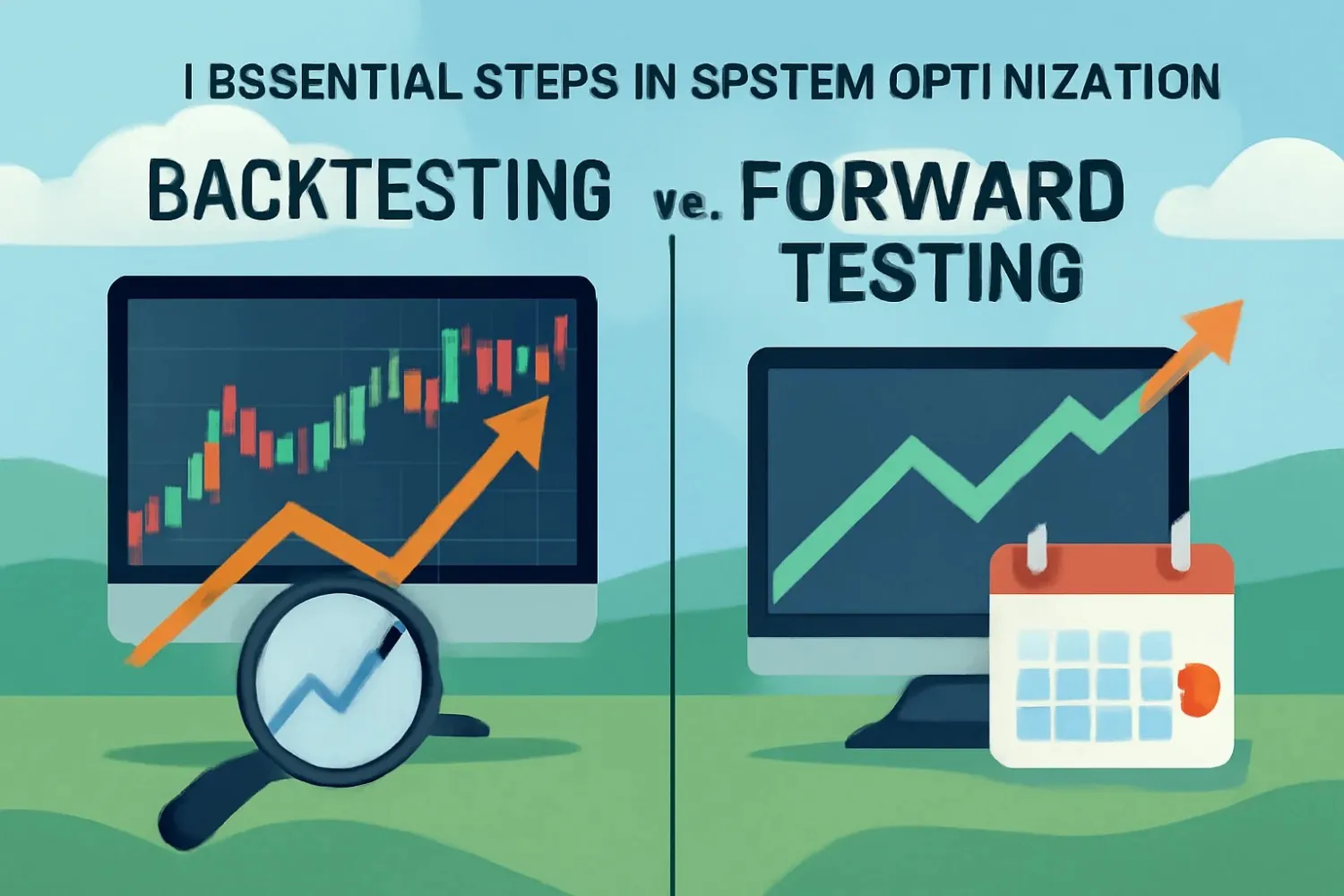
Introduction: The Importance of Testing Your Trading System
When developing a trading system, the primary goal is to ensure that it can consistently perform well in the market. One of the most important aspects of system development is testing. Backtesting and forward testing are the two key methods used to evaluate the performance and robustness of a trading strategy.
While both testing methods are vital, they serve different purposes. Backtesting uses historical data to evaluate a system’s potential, while forward testing simulates real-time market conditions to validate the system’s performance. Understanding the differences and how to use both in your optimization process is essential for developing a trading system that performs well over time.
This article explores the differences between backtesting and forward testing, their respective benefits, and how to incorporate both into your trading strategy for maximum performance.
What is Backtesting?
Backtesting is the process of testing a trading system or strategy on historical market data. The objective is to determine how the system would have performed if it had been used during past market conditions.
How Backtesting Works:
-
Historical Data: The strategy is applied to a set of historical data (price, volume, indicators, etc.).
-
Execution: The system is tested on this data using the entry and exit rules defined in the strategy.
-
Metrics: The backtest generates metrics such as win rates, average gains, maximum drawdown, and risk-to-reward ratios, which help evaluate the strategy’s overall performance.
Backtesting is typically done using software platforms like MetaTrader, TradingView, or NinjaTrader, which offer tools to test strategies across different timeframes and assets.
Benefits of Backtesting:
-
Cost-Effective: Since backtesting uses historical data, it’s a no-risk way to evaluate a trading system.
-
Refining Strategies: Backtesting can reveal flaws in a strategy and help you refine your approach by testing different settings and parameters.
-
Risk Management: It helps identify potential weaknesses, such as high drawdowns or poor risk-to-reward ratios, before risking real capital.
Limitations of Backtesting:
-
Overfitting: There is a risk of designing a system that performs well on historical data but fails in real-time trading because it’s too tailored to past conditions.
-
Market Changes: Markets evolve, and historical performance does not guarantee future results. Events like geopolitical crises, new regulations, or technological changes can affect performance.
-
Lack of Real-World Factors: Backtests cannot account for slippage, transaction costs, or the emotional impact of real trading.
What is Forward Testing?
Forward testing, also known as paper trading, involves testing a trading strategy in real market conditions using either simulated or small capital. Unlike backtesting, forward testing validates the system’s performance in real-time or near-real-time market conditions, which is crucial to assess how well the system performs in the actual market environment.
How Forward Testing Works:
-
Simulated Environment: In a paper trading account, real-time market data is used to execute trades without real money on the line.
-
Real-time Performance: The strategy is evaluated based on live conditions such as slippage, transaction costs, and real market liquidity.
-
Live Data: It uses live price feeds, so the trader can see how the system performs under current market conditions.
Some platforms also provide forward testing on demo accounts, where traders can place trades with simulated capital, allowing them to test their strategy in an environment that mimics live trading.
Benefits of Forward Testing:
-
Real-Time Market Conditions: Forward testing exposes a strategy to the dynamic nature of live markets, including slippage, news-driven volatility, and order execution delays.
-
Emotional Impact: It allows the trader to experience the emotional pressures of live trading, such as dealing with drawdowns, poor trades, and losses, which cannot be simulated in backtesting.
-
Assessing Execution: It reveals how the system performs under real-time execution, accounting for transaction costs, slippage, and latency.
Limitations of Forward Testing:
-
Time Consuming: Forward testing requires more time than backtesting, as it involves executing trades in real-time, even if you’re using a demo account.
-
Initial Risk: While no real capital is at risk in demo accounts, forward testing still requires a trader’s time, attention, and discipline.
-
False Sense of Security: Some systems may perform well in demo environments but fail in live markets, especially when trading real money with live emotional stakes.
Backtesting vs. Forward Testing: Key Differences
1. Timeframe and Data Used:
-
Backtesting uses historical data to simulate how a strategy would have performed over a defined period.
-
Forward testing uses live data in real-time, often in a demo account, or with small real capital.
2. Testing Environment:
-
Backtesting works in a controlled, simulated environment where historical data is already known.
-
Forward testing happens in the actual market environment where slippage, spreads, and other real-world factors come into play.
3. Execution Speed and Accuracy:
-
Backtesting can be faster since trades are executed using historical data.
-
Forward testing involves real-time execution, which can be slower and subject to market noise, slippage, and execution delays.
4. Emotional Impact:
-
Backtesting doesn’t replicate the psychological pressures of live trading, so traders may make different decisions in live scenarios.
-
Forward testing lets traders experience the psychological aspect of trading, such as handling losses and uncertainty.
5. Cost and Resources:
-
Backtesting is cheaper and quicker, as it uses historical data, and most backtesting platforms are either free or come at a low cost.
-
Forward testing can be time-consuming, especially when using demo or small accounts, and often requires more active participation.
Best Practices for Using Backtesting and Forward Testing Together
While each testing method has its strengths, the best approach is to use both in tandem. Here’s how to integrate backtesting and forward testing for maximum performance:
1. Start with Backtesting:
Before moving to forward testing, ensure that your system is optimized using historical data. Make sure you thoroughly test it on multiple market conditions, timeframes, and asset classes to refine your entry and exit points, risk management strategies, and overall system performance.
2. Transition to Forward Testing:
Once you’ve achieved consistent results in backtesting, move on to forward testing in a demo account or with small capital. This allows you to assess how the system performs in live market conditions, including real-time execution and emotional responses.
3. Monitor and Refine:
-
Adjust as Needed: If forward testing reveals issues that weren’t apparent in backtesting, make adjustments. Optimize your system based on live performance while retaining the core rules.
-
Use Walk-Forward Testing: Incorporate walk-forward analysis, where you test a strategy in one period, optimize it, and then test it on an out-of-sample period. This ensures your strategy isn’t overfitted to historical data.
-
Continuous Improvement: Use feedback from forward testing to refine your strategy, ensuring it’s robust, adaptable, and resilient in various market conditions.
Conclusion: Maximizing Performance with Both Testing Methods
Backtesting and forward testing are both essential steps in the journey to developing a successful trading system. Backtesting provides a solid foundation by evaluating historical performance, while forward testing allows you to validate your strategy in real-time, accounting for market dynamics and emotional challenges.
For maximum optimization, use backtesting to refine your strategy, then validate it through forward testing. This balanced approach ensures that your trading system is both profitable and practical, equipped to handle real-world market conditions and capable of providing consistent, long-term results.